You Don't Have to be at the Edge
It's called the edge because there is a cliff on the other side
The other day I was having a conversation with an intern at my current company, and they mentioned they were having a great experience. When I asked why, they said the company was reasonable. Not the compliment I expected, I should say. According to them, teams were collaborative and people helped each other. AI was incentivized but there were no quotas. And this had not been their experience in past internships.
That confirmed my suspicion that being reasonable is a strength in tech. Companies are constantly trying to chase the latest trend. There is a feeling that if you are not using the last leadership or technology practice, you are behind. The result is an industry that seems driven by memes.
The list is long. In my career, Agile was likely the first big one. While the ideas there were revolutionary and changed the industry for the better, they became the most common antipattern when adopted blindly across the industry. Then we had the Spotify model, which was sold as a solution for most teams way past when it was actually used by its creators. More recently founder mode, or even tokenmaxxing. The problem is not the ideas per se, as they make sense within context. The problem is how we copy them without thinking too much about it.
Take tokenmaxxing as an example. The most current and meme-like one. If you’re trying to change the behavior of tens of thousands of people in a company, incentivizing indiscriminate AI usage gets you there. You will surely spend a lot on many useless endeavours, but you will create a habit. It also helps if your budget is something close to infinite. That same technique doesn’t make sense for a startup of 10 that has limited runway. In that case, just get people in a room and agree how to use AI.
Unfortunately these memes have meaningful consequences. While they are quick to be adopted, it takes a long time to let them go. Companies have spent a lot of money on tokenmaxxing, for one. But in a more dramatic example, for years the industry has applied technical interviews that were created for mass interviewing (with questionable results there as well) in companies that are hiring a single-digit number of engineers in a year.
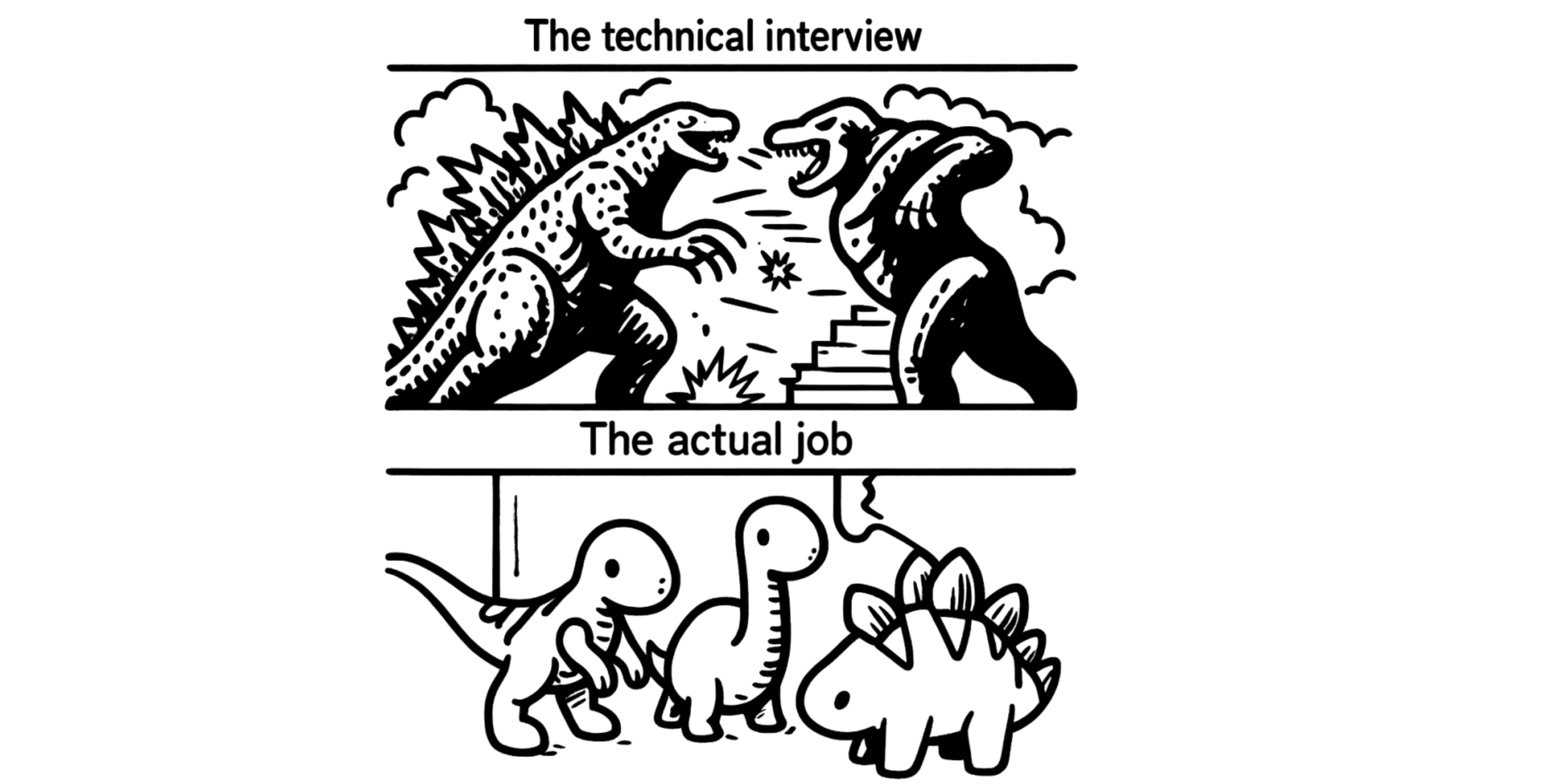 Leetcode, anyone?
So what do we do? We surely cannot just avoid innovation. The industry needs to evolve and change. But how do you avoid falling into a trap of mindlessly following a trend?
Firstly, understanding that each context is unique. Your company and team are different. The business is different, the culture is different, the technology is different, the people are different. That is what makes leadership interesting and challenging. What works for others might not work for you, in the same way that what works for you won’t work for others. There is no point in copying a company only because they are big, especially if you are small (if you’re going to, copy what they did when they were small).
Leadership’s role is to drive direction in a very complex system, and to do that you need to deeply understand it. What is your goal? What are the bottlenecks and challenges in achieving them? What are the strengths and weaknesses of your team members? Having that perspective will allow you to filter new ideas from the start. If changing something doesn’t help with a problem you actually have, you probably shouldn’t do it.
Secondly, if you need to become good at something, become good at experimenting. That is the only way to ensure you are doing it right. I once had this realization while reading the newspaper. I had started working in tech and realized that the tech news was mostly simplistic and somewhat incorrect. And then I realized that the whole newspaper was probably like that, I just didn’t know enough to perceive it (and later that became a thing).
I’m telling this story because what we read on a blog post or hear in comments from “someone that works at X” is certainly the simplistic version of a much more complex reality. That famous technique likely doesn’t work as well as stated, even where it was created. They probably made a lot of trade-offs, maybe some you can’t make.
The solution for that needs to be strong experimentation. You’d like to see if loop engineering works? Define the experiment, state the results you are aiming for and try it within a group. If it works, expand it. By definition, experiments need to be constrained, otherwise you won’t be able to see the difference. And that is the anti-pattern that many companies fall into. Let’s change the way we run projects. Did it work? Not sure, projects are still being delivered somewhat, and given the company context changed so much in the past year, we can’t really tell the difference.
Experimenting is also how you can be at the edge without risking the whole company. You can try things, iterate, fine tune them until they work. And everything around it still runs without the risk of disruption.
Lastly, you don’t have to be the first, you can be a great follower. We have a healthy fear of disruption in technology, but the solution is not to change direction all of a sudden. Fatal disruptions are hard to copy, and their stories read like rise-to-fame ones. It all happened in one day after 10 years of silent work.
Take the current AI cycle. AI is certainly changing everything about software, and the industry is never going to be the same. At the same time, most companies are not seeing revolutionary results yet. If you start today you can catch up. And this anxiety is not only affecting companies, but also individuals. The alarming sentence is “if you don’t learn AI now, you will miss the boat”. I’m pretty sure I can learn the winning patterns after everyone else figures out what works and what doesn’t. To be clear, you should be heavily using AI by now, and if you’re not, you are late. But the reality of the situation doesn’t match the anxiety of the discourse.
If the goal is to follow quickly, then the focus is again on execution. The more your team and company are great at fundamentals, meaning how fast you can deliver, the easier it will be to adapt and catch up when the trends start to stabilize.
You might be thinking that this sounds great but you can’t control your environment. That is true, but it is for any role (even the CEO has multiple bosses). You can influence your context wherever you are. Deep understanding of your environment, rapid experimentation, and strong execution. Whether you are an IC, a manager, or an executive, if you can achieve that you will get results, and results are ultimately what give you influence.
And while others might be exhausted from running around to figure the new pattern out, and some fall off the cliff, you can be the first to be successful with it.

Comments