How is it going?
Reporting up as an Engineering Leader
 How is it going?
Last year, for the first time in a while, I had to report directly to a manager. I have been in technology for over 15 years, in management for the last 10, and I had never stopped to think about how I communicate the state of the world to my manager.
I’ve been in many situations like that with the teams I manage though. My engineers have run their projects and came to me with updates which I needed to give feedback and provide support. I never thought I’d struggle to do it from the other side.
The central question is: how do you demonstrate competence while exposing problems and seeking assistance?
The Standard Approach
The most common way to report is to focus on what you have done or are about to do. It demonstrates action bias and it is a natural way to communicate. But it carries some risks:
- Missing the big picture: detailed discussions about specific problems can overshadow the broader team or department context
- Enabling misunderstandings: unaddressed external constraints may appear as leadership blind spots
- Overlooking emerging concerns: small issues that require awareness rather than action can later seem like surprises
The Team Dashboard
To balance immediate actions with comprehensive visibility, I adopted a team dashboard divided into four key areas:
Metrics — tracking delivery and technology performance such as velocity changes and defect trends.
People — assessing engineer fulfillment and interpersonal concerns.
Process — evaluating how the team collaborates and works together.
Delivery/Technology — summarizing overall team output and technical health.
Each area includes a status color indicator, supporting notes with reasoning, and immediate action items. This format provides rapid awareness without requiring extensive discussion, enables healthy disagreement, and creates historical context for reflection.
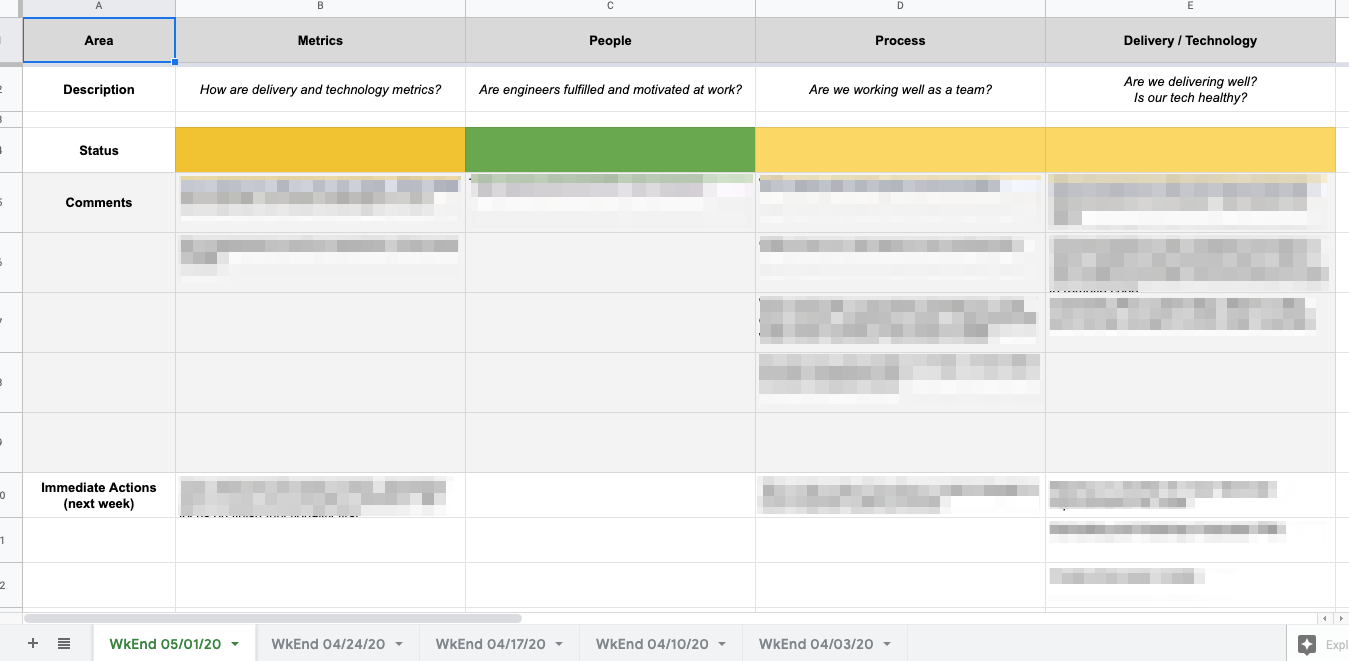 Team dashboard example
Metrics tracking itself deserves a separate discussion, which I will cover in the future.

Comments