Uncertainty
 Uncertainty
This post explores why intuition and uncertainty remain undervalued in corporate and software development environments, drawing inspiration from a lecture by Ricardo Semler at MIT Sloan School of Management in 2005.
Semler discusses intuition’s critical role in problem-solving, using the famous Kasparov vs. Deep Blue chess match as an example. He poses a thought-provoking question: how is it possible, at all, for something with 4 moves (Kasparov) to play something with 4,000,000 moves (Deep Blue)?
The answer, according to Semler, lies in intuition — something machines lack but humans possess naturally. Yet organizations systematically ignore this advantage.
The Core Problem
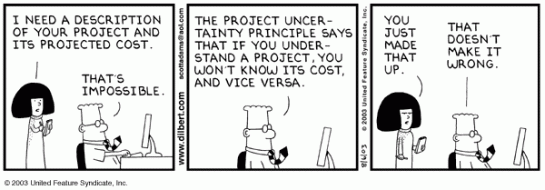
Why do people resist accepting uncertainty and intuition? Instead, organizations prefer creating illusions of control through rigid planning methodologies that have repeatedly failed, rather than embracing flexibility and team judgment.
Relevance to Software Development
This disconnect proves especially damaging in agile adoption. Teams struggle accepting that:
- Project timelines cannot be precisely measured
- Scope must remain flexible as priorities emerge
- Decisions should rely on team intuition rather than complex calculations
Organizations choose detailed estimates offering false precision over realistic approximations like “roughly 1 month,” hoping to maintain control over budget, size, scope, and quality simultaneously.
As Semler observed: it doesn’t matter if you are wrong, but you have to be precisely wrong.

Comments